| Natural Elements | |
| Space can be a very dangerous place. This page lists all of the natural elements that you may come into contact with as you explore the galaxy. Some only occur in one location, others are completely random and may appear anywhere. Thanx to Robert Skippie for his suggestion on adding these elements. Note that many other spacial anomolies exist, and as these anomolies are studied, information about them will appear here. Elements listed as "drifting" are constantly moving through space. Elements listed as "stationary" do not move, and will often be marked on the map for future reference. |
Asteroid Fields | |
| Location: Random (drifting or stationary) | Danger To: Small ships |
Description: Asteroid fields can cause problems for small ships, as their deflectors will usually not be very powerful. If an asteroid should hit a ship, it would do great damage to its hull. Larger ships (hull size 4+) still have to worry about some asteroid fields, if a large asteroid was to hit a warp nacelle, the ship would be in trouble. Stationary asteroid fields will be marked on the map by  . . | |
Badlands | |
| Location: Sector 502x499 | Danger To: Large Ships |
| Description: Known as the "Badlands", this area of space contains several unstable, highly charged plasma fields. There have also been reports of severe local neutrino disturbances. The common plasma storms that occur in this area make navigation difficult, and prevent the use of warp drives. Only small ships (hull size 1-3) may pass through the Badlands at full impulse. Medium-sized ships (hull size (4-6) may pass through the Badlands at half impulse. Large ships (hull size 7+) will become disabled should they attempt to enter the Badlands. It is believed that the Maquis Homeworld is hidden somewhere in this sector. | |
Black Holes (Quantum Singularities) | |
| Location: Random (stationary) | Danger To: All ships |
Description: Black holes are dead stars which have collapsed due to their high gravity. A ship which passes the event horizon (rim of gravimetric field), will be pulled into the quantum singularity. It is extremely difficult to escape the clutches of a quantum singularity. As they are discovered, black holes will be marked on the map by  . . | |
Ion Storms | |||
| Location: Random (drifting) | Danger To: All ships & colonies | ||
Description: Ion storms can be very deadly. A ship travelling through an ion storm is at risk of having all systems disabled. When an ion storm is found, you will recieve the coordinates of the center of the storm, as well as a size. This size is an indication of the number of hexes around the center that are occupied by the storm. Travelling within 1 hex of the outer edge of the storm may result in some system failure. Note that ion storms disrupt all attempts at communication, and may also disable cloaking devices and shielding technologies. Ion cannon technology is based on the effects of these storms.
| |||
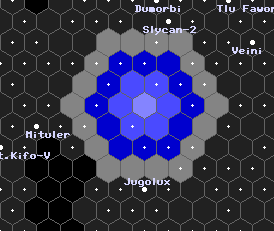
 Center of the Ion Storm. Maximum damage.
 Inner area of Ion Storm. 75% damage.
 Outer area of Ion Storm. 50% damage.
 Area around Ion Storm. 25% damage
Micro-wormholes | |
| Location: Random (drifting or stationary) | Danger To: None |
| Description: Micro-wormholes are similar to wormholes except that travel through them is almost impossible due to their size. However, it could be possible to send a subspace message through a micro-wormhole. | |
Mine Fields | |
| Location: Fixed (stationary) | Danger To: All ships |
Description: Although they are not a natural occurence, this seems a good place to put them. Mine fields can do great damage to ships passing through them, although mines that are not cloaked can usually be destroyed from a distance without much problem. Mines become far more deadly once self-replication is achieved. When possible, mine fields will be marked on the map by  . . | |
Nebulae | |
| Location: Random (stationary) | Danger To: Varies |
Description: Nebulae effects can vary greatly. There appears to be very few common effects. Ships will need to scan a nebula in order to determine its effects. If scans are conducted on a nebula, its effects will be listed seperately. Known nebulae are marked on the map by  . . | |
Plasma Fields | |
| Location: Random (stationary) | Danger To: Large Ships |
Description: Unstable, highly charged plasma fields are not only found in the Badlands. They can be found throughout the known galaxy. The plasma storms that occur in these areas make navigation difficult, and prevent the use of warp drives. Depending on the severity of the plasma storm, ships as large as hull size 5 may travel safely. Other ships run the risk of taking serious damage, and are not advised to attempt to enter a plasma field. Plasma storms have three levels of danger:
| |


Plasma Storms | |
| Location: Random (drifting) | Danger To: Large Ships |
| Description: Like plasma fields, random plasma storms make navigation difficult, and prevent the use of warp drives. Depending on the severity of the plasma storm, ships as large as hull size 5 may travel safely. Other ships run the risk of taking serious damage, and are not advised to attempt to enter a plasma storm. Like ion storms, when you find a plasma storm you will be given the coordinates of the center of the storm, as well as a size. You will also be given an indication of the danger of the storm. | |
Wormholes | |
| Location: Random (drifting or stationary) | Danger To: None |
| Description: Wormholes allow travel to remote areas of the galaxy. However, they are rarely completely stable. By scanning a wormhole, you will recieve a report of its stability and current destination. Note that both sides of a wormhole have an independant stability, so the side you are scanning could be 100% stable, while the other side is only 10% stable. Travel through a wormhole is done at your own risk. Use the command goto (WORMHOLE) to travel through a wormhole that is in your current sector. If one side of a wormhole loses stability, it will move. Any ship that enters a wormhole will exit the other end. Wormholes will not be marked on the map at this stage. | |